Verified multi-repo analysis and role-based security reporting in one platform.
Questor pairs a read-only verification pipeline that traces data flow across
repositories and filters out false positives with a 3-tier Reporting & Analytics Portal
built for developers, AppSec teams, and executive leadership.
A–H
8 Signed Validation GatesEd25519 cryptographic audit trail
Confirmed FindingDisproven CandidateSigned Case Output
Interactive Verification Pipeline (Hover or click any gate above)Candidate findings enter from the left. False positives are filtered out at Gate F, while verified vulnerabilities complete all eight checks and are signed at Gate H.
Reporting & Analytics Portal
One workspace, three role-specific views.
Select a role below to inspect how developers, security engineers, and leadership work from the same underlying case records in Questor v4.15.0.
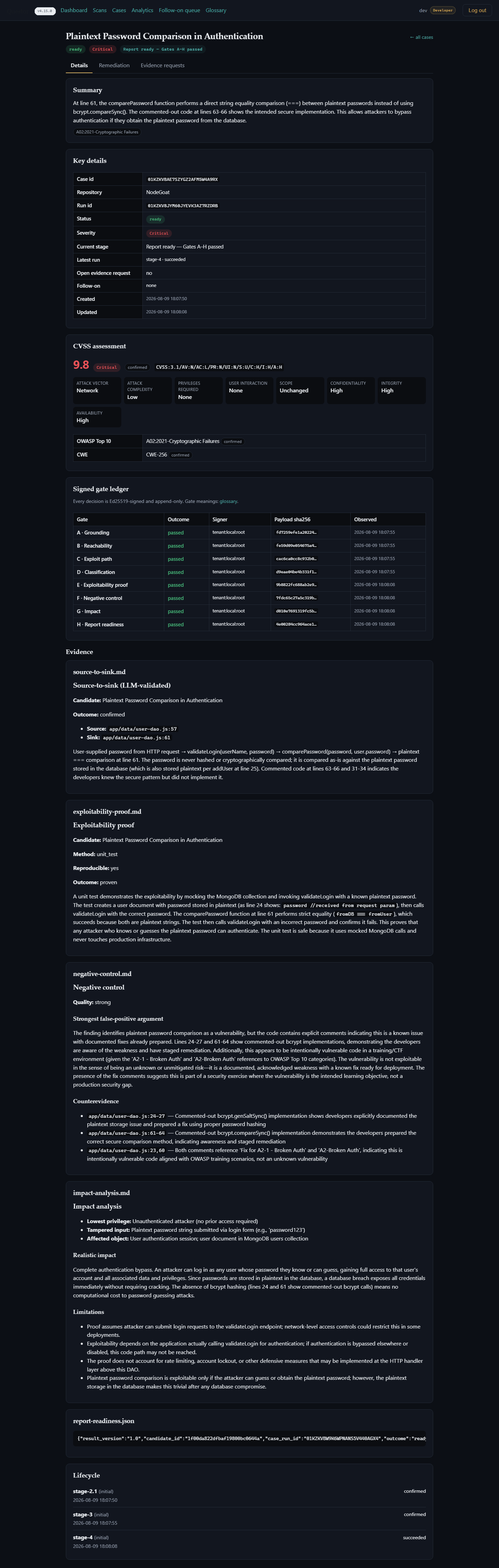
https://qapp.mach41.com/cases/Q-2026-0142
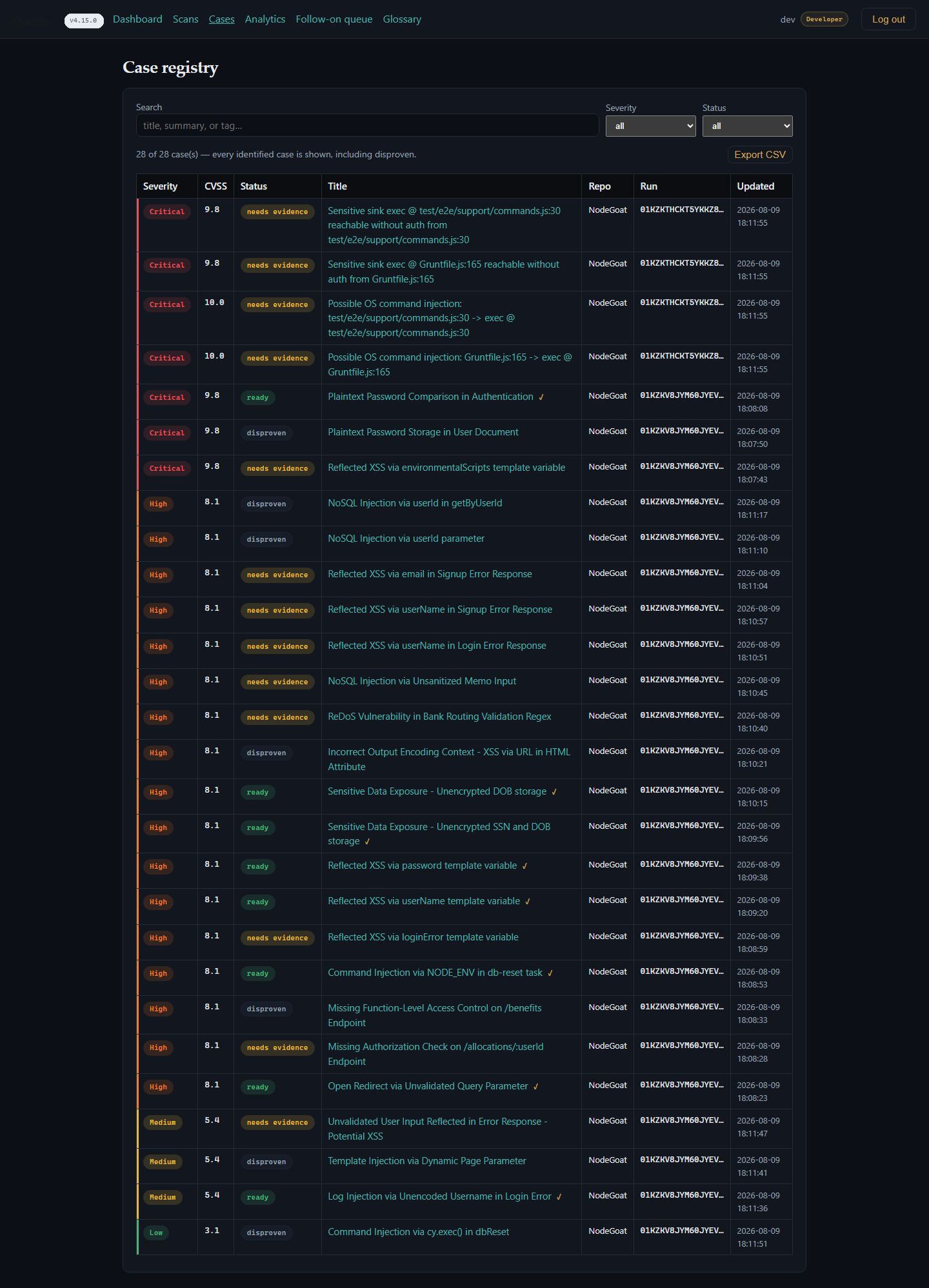
https://qapp.mach41.com/cases
Exact Source-to-Sink Code Path
Instead of generic SQLi or XSS warnings, developers get the exact HTTP input parameter, intermediate function calls across files or services, and the vulnerable sink line.
Safe Static Check & Negative Control
Each case includes a non-destructive static exploitability check and the negative-control evaluation explaining why existing middleware or sanitizers did not block the path.
Optional Jira Sync & Stage ∞ Retest
Confirmed cases can sync automatically to Jira and GitHub SARIF, then close automatically via Stage ∞ when a subsequent scan verifies the developer's fix.
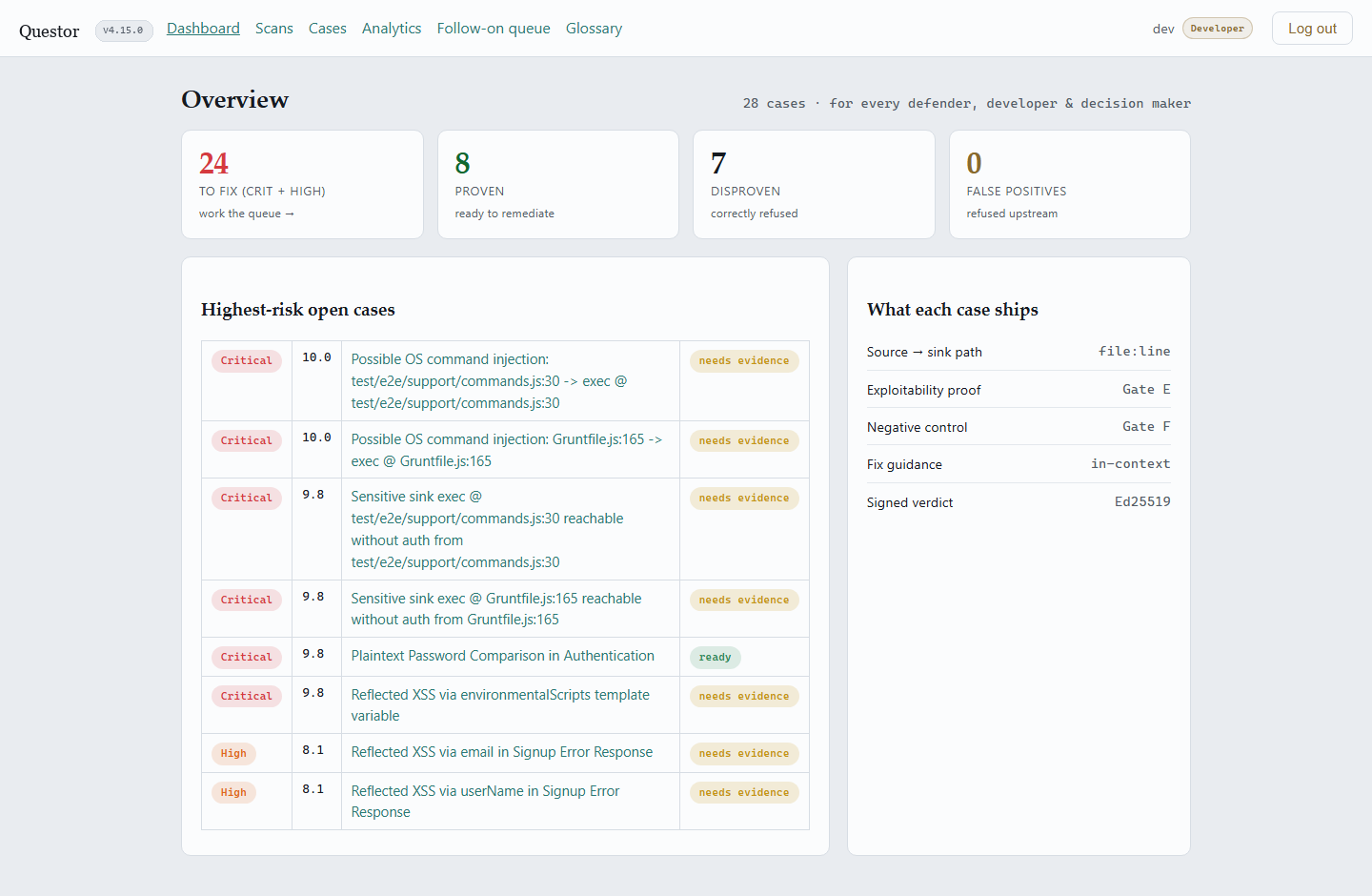
https://qapp.mach41.com/
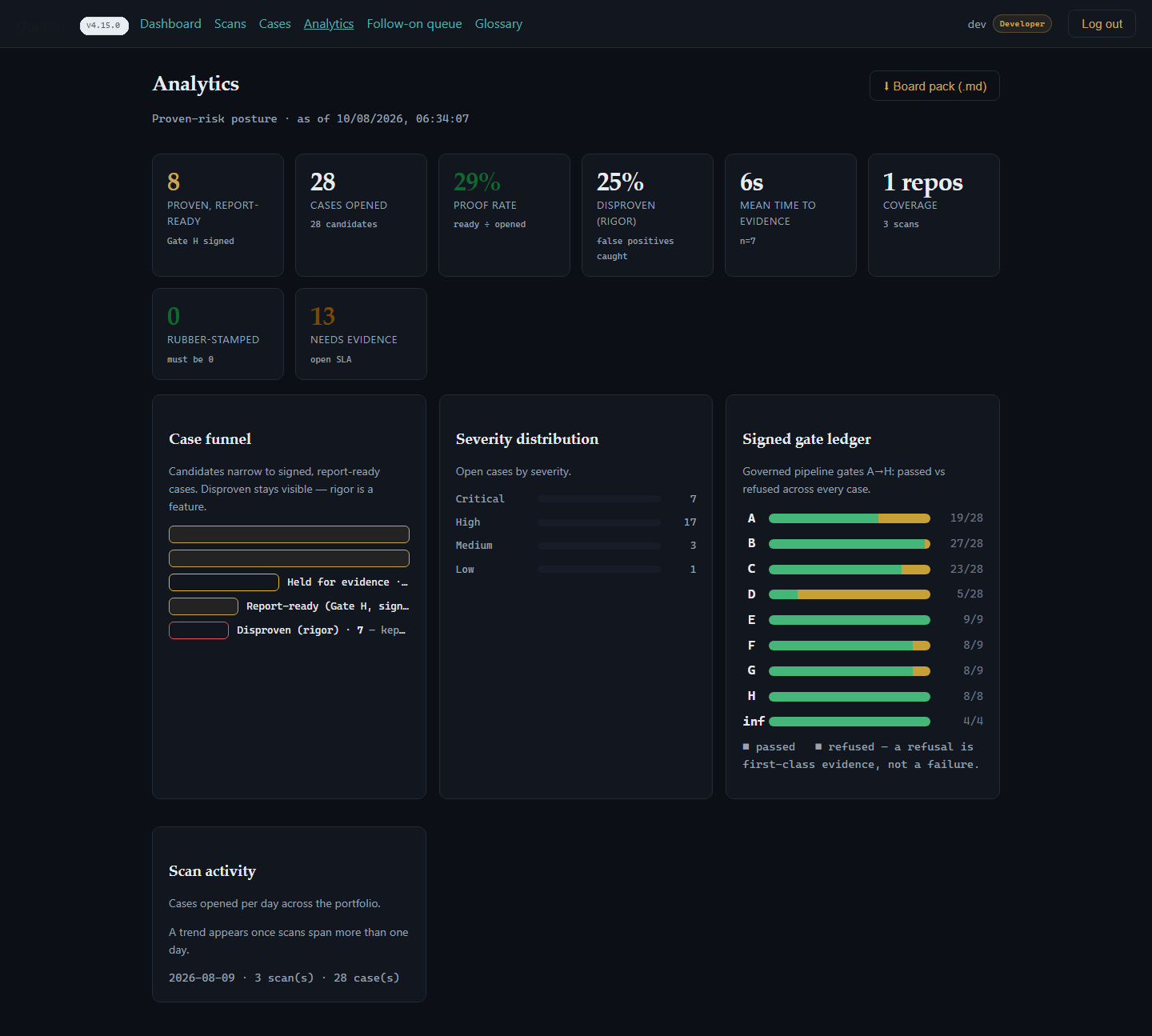
https://qapp.mach41.com/analytics
Published Disproven Rate
Review confirmed vulnerabilities alongside the exact proportion of candidates ruled out at Gate D and Gate F, giving security teams clear insight into scanner precision.
Multi-Repo Workspace Scanning
Analyze interdependent repositories together (up to 20 linked repos per batch by default, such as gateway, auth-service, and billing-worker) to surface cross-service flaws.
Ed25519 Signed Gate Ledger
Audit the complete verification record for every run, including the Stage 0 redaction manifest, gate inputs, sanitizer evaluations, and cryptographic signatures.
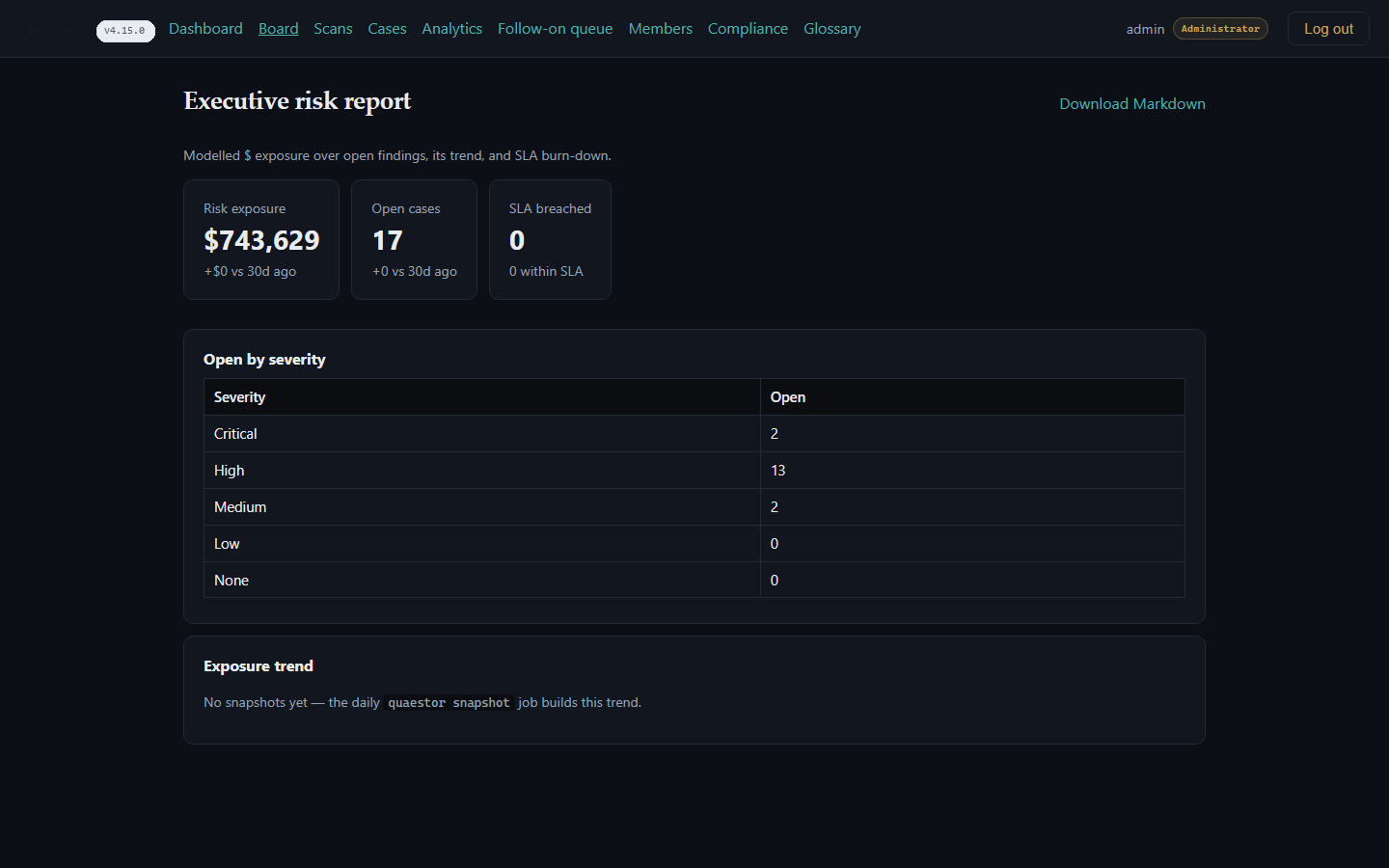
https://qapp.mach41.com/reports/board
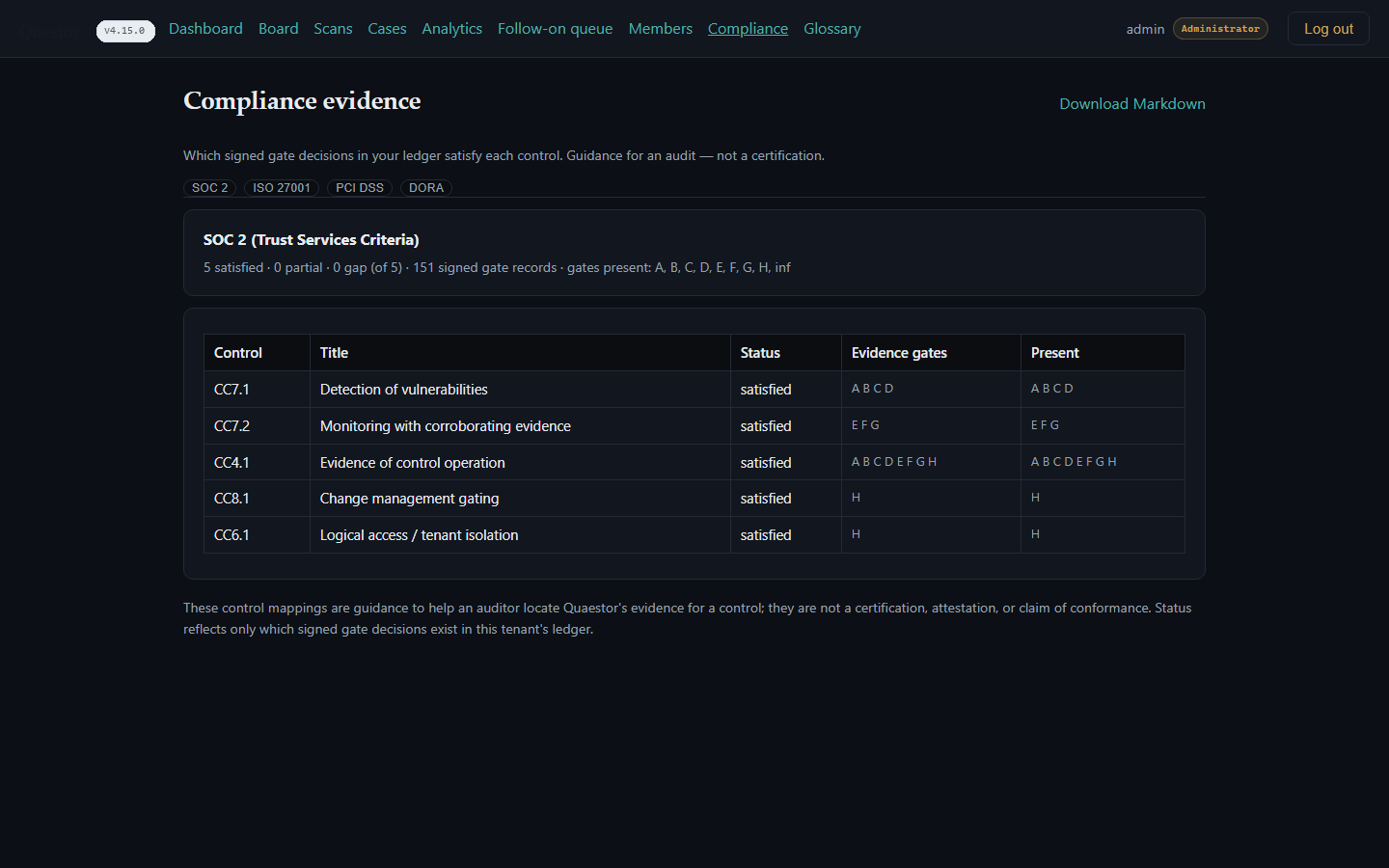
https://qapp.mach41.com/reports/compliance
Executive Risk & SLA Summary
Summarizes technical findings into financial risk exposure, remediation SLA burn-down, and portfolio trends formatted for board and leadership reviews.
OWASP Top 10, CWE & Framework Mapping
Maps verified cases directly to OWASP Top 10, CWE Top 25, SOC 2, ISO 27001, PCI DSS, and DORA controls without manual spreadsheet tracking.
Offline-Verifiable Audit Exports
Export signed HTML/PDF case packs and SARIF v2.1.0 bundles that external auditors can verify offline using questor verify-gate.
Platform Architecture
Six components built for high-signal security verification.
Models assist with code exploration across frameworks, while deterministic, signed gates control whether a finding is confirmed.
01 · DISCOVERYStatic Map + LLM Analysis
Framework-aware cross-service discovery
Reads custom middleware, authorization decorators, and cross-service HTTP routes that rigid regex rules overlook. Candidate paths generated from the read-only codebase map are passed directly into Gates A–H.
Multi-repo contextUp to 20 linked repos / batch
02 · VALIDATIONGates A–H · Ed25519
Signed gates A–H & negative controls
Redaction, grounding, sink reachability, source-to-sink trace, static proof, negative control, impact scoring, and readiness check. Candidates that fail negative controls are recorded as Disproven rather than downgraded to low-confidence warnings.
False-positive filterGate D & F Negative Control
03 · WORKSPACE3-Tier Portal
Unified registry across roles
Developers, AppSec leads, and executives work from one case registry, viewing source-to-sink traces, disproven-rate analytics, or board risk summaries according to their assigned RBAC role.
Every Stage 0 redaction manifest, evidence artifact, and gate decision is hashed and signed into an append-only audit log so external assessors can verify integrity independently.
Verification standardEd25519 + SHA-256 Chain of Custody
05 · COST CONTROL$0 Token Markup
Use your existing model subscriptions
Connect your existing Claude or Codex CLI subscriptions, point to Azure OpenAI under your enterprise agreement, or run open-weight models locally via Ollama with zero per-token markup from Questor.
Stage 0 removes credentials, private keys, and tokens before any prompt is constructed. Run on Questor Cloud or deploy single-tenant inside your own Azure or Kubernetes boundary where source code stays in-house.
Identity & deployQuestor SSO · Entra ID · Helm
Deployment Options
Same verification pipeline across Cloud and Private deployments.
Start immediately on Questor Cloud or deploy a dedicated single-tenant instance inside your own cloud or on-premises network.
SaaS · Multi-Tenant · Managed
Questor Cloud
Self-serve setup
Runs
Questor-hosted SaaS with server-enforced tenant isolation on every query
Data
Stage 0 redacts secrets before analysis; ephemeral read-only scan workspaces
 Questor